On March 13, 2026, an apartment at 34-20 78th Street in Jackson Heights sold for $310,000. Thirteen days later, an apartment at 33-27 80th Street sold for $1,175,000. The two buildings are about three blocks apart on the 34th Avenue corridor. Both are in the 11372 ZIP code, and New York City's Department of Finance files both under the same category, elevator co-op apartments.
If you are comparing neighborhoods, you have probably seen a single Jackson Heights co-op number. PropertyShark puts the median co-op sale at $340,000 for the third quarter of 2026, down 6.2% from a year earlier, across 69 transactions. That figure is accurate, but it averages several different markets. In this part of Jackson Heights, the year a building went up predicts its price band better than the median does. Within each band, the building's upcoming repair schedule decides how much of that price you keep paying after closing.
What the $340,000 median is made of
Jackson Heights is a co-op neighborhood. PropertyShark's housing-stock count for the area lists 6,951 individually owned co-op units and 1,019 condos. Most of the buying here is co-op buying, so most of what shapes that median is the co-op stock.
That stock comes from three eras. Between 1916 and the mid-1920s, the Queensboro Corporation built garden-apartment complexes such as The Chateau and The Towers. In the late 1930s came Moderne buildings like Dunolly Gardens. After World War II came a wave of six-story elevator buildings. The Landmarks Preservation Commission's 1993 designation report for the Jackson Heights Historic District describes the postwar buildings as large six-story structures with lightcourts and courtyards, plainly decorated, whose siting, massing and materials "harmonize with the earlier fabric of the area." On the street, the eras blend. In the sales records, they separate clearly.
Three eras, three price bands
The Department of Finance's Queens rolling sales file covers every recorded sale from November 2025 through October 2026, with data as of November 10, 2026. Each row lists the year the building was built. If you sort the co-op sales around 34th Avenue between 74th and 82nd Streets by that year, three bands appear. The figures below leave out the $0 transfers, which are not market sales.
| Construction era | Where | Recorded sales, Nov 2025 to Oct 2026 | Range | Middle sale |
|---|---|---|---|---|
| 1950 to 1952 | 33-15 and 33-35 81st St, 33-16 and 33-26 82nd St, 34-20 to 34-40 78th St, 34-15 74th St, 76-10 and 77-02 34th Ave | 31 market sales | $176,970 to $500,000 | $299,000 |
| 1939 | Dunolly Gardens block, 78th to 79th Streets, 34th to 35th Avenues | 15 | $150,000 to $655,000 | $340,000 |
| 1922 | The Chateau's block, 80th to 81st Streets | 7 | $745,000 to $1,175,000 | $925,000 |
The Towers, built in 1923 on the block just north across 34th Avenue, recorded two sales in the same window: $1,175,000 at 33-27 80th Street in March 2026 and $999,000 at 33-51 80th Street in July 2026. The city's 2025 annual file shows the top of that band a year earlier, with $1,355,000 at 33-15 80th Street on February 5, 2025, and $1,250,000 at 34-06 81st Street on February 3, 2025.
Two things stand out. First, the 1939 block's middle sale over the twelve months was $340,000, the same as PropertyShark's third-quarter median for the whole neighborhood. The headline number describes a Dunolly-era apartment much better than a Chateau apartment. Second, the bands barely overlap. Six of the seven sales on The Chateau's block cleared $900,000, while no sale in the 1950 to 1952 buildings went above $500,000. A buyer with a $450,000 budget and a buyer with $950,000 are shopping on the same streets, but they are not competing for the same apartments.
What a 1920s price pays for
Apartment size likely accounts for much of the gap between the bands, and the 1920s complexes were built at a different scale from everything that came after them.
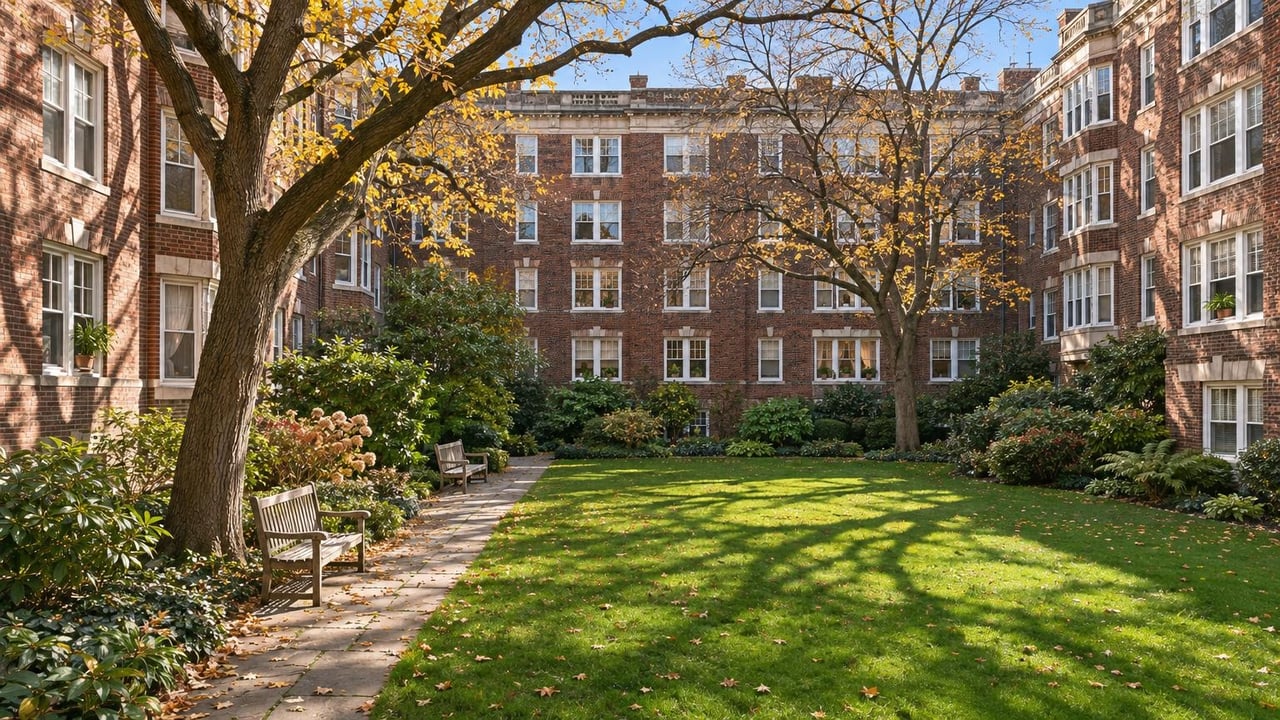
The LPC report dates The Chateau to 1922 and The Towers to 1923-25. It describes each as covering "almost a full block," with the ends facing 34th Avenue. Their long interior gardens run to the lot line, and the avenue's historic median once linked them into a two-block greenway. Andrew J. Thomas designed The Chateau with French-inspired mansard roofs and patterned brickwork. The Towers is Mediterranean in style. The Jackson Heights Beautification Group's history of the neighborhood notes that Edward MacDougall, head of the Queensboro Corporation, lived at The Towers in "a top-floor 14-room duplex," and it cites a seven-room, three-bath apartment as another example. Those are the developer's showpiece apartments, not typical ones. Still, they indicate the kind of layouts that sell above $900,000 on 80th and 81st Streets.
Dunolly Gardens, completed in 1939 and also designed by Thomas, was built smaller. The co-op's own site describes layouts ranging from studios to two-bedroom, two-bath apartments. Its buildings cover only 45% of the 126,000-square-foot lot, and much of the rest is garden, including a central courtyard. The LPC report calls its spare Moderne design a contrast to the historical styles of The Chateau and The Towers. For a buyer, that means a garden setting in the historic district at the price band the neighborhood median describes.
One way to judge the 1920s premium for yourself is to see the gardens. The interior gardens are private co-op common space, not public parks, so you usually see them from the street. The Jackson Heights Beautification Group's annual Historic Jackson Heights Weekend opens as many as 15 of them on a self-guided tour, alongside escorted walks through the historic district. In 2025 the garden tour ran on June 14 and cost $15, as It's in Queens reported. If you are planning a spring 2027 purchase in one of these complexes, it is worth putting that weekend on your calendar.
The 1955 building that breaks the pattern
Construction year is a strong signal, but it does not settle the price. At 79-10 34th Avenue, a building the city lists as built in 1955, the twelve-month record shows sales of $525,000, $860,000, $875,000 and $905,000, along with one at $225,000. The top three sit right next to the low end of The Chateau's block, which is directly across 80th Street.
The $225,000 and $905,000 sales in that one building show that unit size and layout can move a price as much as the building's era does. Because the public record leaves size out, two apartments that look similar in the sales file can be very different homes. The practical lesson for comparing sales is to look up comparable sales by building and by line, then confirm room counts, before treating any block's numbers as your ceiling or your floor.
The second number to ask for: the building's repair calendar
Once you know a building's price band, the purchase price is only part of your cost. Every co-op in the table went up between 1922 and 1955, and the big repair projects that come with buildings of that age land on shareholders as higher maintenance or assessments.
Habitat magazine's September 2026 issue described a 360-unit, six-building Jackson Heights co-op with more than 400 shareholders that took on a $22 million refinance. Its underlying mortgage, its next Local Law 11 facade cycle and about $7.6 million in masonry and pointing work all arrived at the same time. The board raised maintenance 10% and added a $7-per-share assessment. As of that report, the work was in its third and final phase and running close to budget.
The Berkeley, a 1936 garden co-op in the neighborhood designed by Joshua Tabatchnik, is a second example. Habitat reported that it replaced more than 2,600 windows in a $5 million project with Landmarks approval, paid for in part by an average $100 monthly assessment over three years. In Habitat's January 2026 interview, the board's president said at least $1 million in facade repairs was still ahead.
Neither example is a reason to avoid a building. A co-op that has just finished its facade cycle may be a better buy than a cheaper one where that work is still ahead. For a buyer comparing two apartments in the same price band, the useful question is where each building stands on its schedule of mortgage maturities, facade cycles and window or roof work. A $299,000 postwar one-bedroom with a finished facade job and a $299,000 one with the job still to come are different purchases. Our step-by-step timeline for buying in Jackson Heights shows when in the process the building's financials reach you. If you are still deciding between ownership types, our co-op vs. condo guide for Jackson Heights covers that first.
The figures in this post are recorded sales and reported building costs, shared as general information, not legal, tax or financial advice. Please confirm your own situation with an attorney, accountant or lender before you act on them.
If you are weighing a postwar one-bedroom against a garden-complex apartment on 80th Street, bring the addresses to Kunal NYC Real Estate. Schedule a personalized consultation, and we will go through the recorded sales on those 34th Avenue blocks with you, one building at a time.